
the fun facts machine

eng/fin/chin
i dunno what much to tell about me :p i draw, i uhh, exist, play the piano and yeah :D i enjoy stuff
mood?

piano pieces i've learned
la valse d'amelie
comptine d'un autre été
where's my love
fallen down
Rue des trois frères
golden brown
carol of the bells
final duet
trying to learn:
none
hi!
I am mittarulla. This is like a sad attempt to have a place where to put my portfolio and let other people learn about me. completely a WIP rn, probably always will be. this website is hand coded and stitched together with tutorials :D


Shuriken from Phighting!
click on him to learn more!
i also play the game a lot
minesweeper
click here to play!


Hades
i play this game a lot. only rougelike
i enjoy lol- trying to 100% it right now!
Steam page
☆ i play the piano
☆i enjoy drawing
☆i don't like soda or bubbling water or ahything like that
☆ my favorite color is blue

basically i learn something new every week and make a short report here.

sheep are a domesticated ruminant mammal typically kept as livestock.
Sheep are members of the order Artiodactyla, the even-toed ungulates. there are around 1 . 2 billion domestic sheep as of 2019. An adult female sheep is referred as a ewe, an intact male as ram, occasionally a tup, a castrated male as a wether and a young sheep a lamb.
Sheep are herbivorous, most breeds prefer to graze on grass and other short rouhage. Sheep are flock animals and strongly gregarious. All sheep have a tendency to congregate close to others members of a flock. sheep can become stressed when separated from their flock members.

stingrays are a group of rays, a type of cartilaginous fish, which means their skeleton is promarily cartilage. Stingrays diverged from their closest relatives, the panrays, during the late jurrasic period. they are common in coastal tropical and subtropical waters. there are species of stingrays in the deep ocean and some stingrays, like the river stingrays, that live in fresh water. most stingrays feed on mollusks, crustaceans and occasionally, small fish. freshwater stingrays in amazon feed on insects.
Stingrays are usually not aggressive, and will only attack humans if provoked. The stinger of a stingray is known also as the spinal blade. It is located in the mid-area of the tail and can secrete venom. the injury is painful, but rarely fatal. There are currently only two recorded deaths, the latest one being in 2006.
Stingrays are proggressively becoming threathened or vulnerable to extinction, particularly as a consequence of unregulated fishing. there are over 40 species of stingrays are considered threathened, and around ten critically endangered.
radiodonta is an extinct order of stem-group anthropods during the cambrian period that lived in water. they were amongst the earliest large predators. some of the most famous species are anomalocaris canadensis, hurdia victoria, peytoia nathorsti, titanokorys gainesi, cambroraster falcatus and amplectobelua symbrachiata.
most radiodonts were significantly larger than the other cambrian fauna, with typical body lengths of large taxa varying from 30 to 50 cm. the largest described radiodont is the aegirocassis benmoulai, which may have grown up to 2 meters long.
radiodonts had lots of different ways to acquire food, which could be categorized as raptorial predators, sediment sifters or suspension, filter feeders. raptorial predators like anomalocaris and amplectobeluids might have been able to catch prey by using their raptorial frontal appendages. sediment sifters like Hurdia and Peytoia form a basket-like trap for raking through sediment and passing food items using their endites.
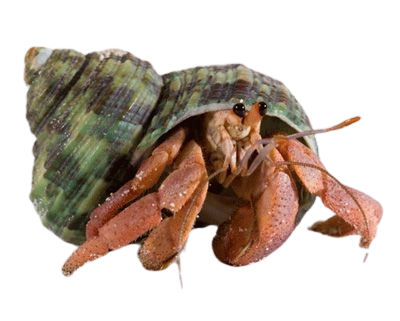
hermit crabs are anomuran decapod crustaceans of the superfamily paguroidea. they have adapted to occupy empty gastropod shells to protect their abdomens, because their abdominal exoskeletons are soft(non-calcified).
there are over 800 species of hermit crab, most of them elvolved from symmetric, free-swimming larvae to asymmetric, shell-seeking crabs. well, they are not true crabs. they are more closely related to certain kinds of lobsters than crabs. out of the 800+ species, almost all are marine hermit crabs, with a dozen semi-terrestrial species. there is only one species of freshwater hermit crabs.
hermit crabs are omnivorous scavengers and are mostly nocturnal. they eat microscopic mussels and clams, bits of dead animals, and microalgae.
hermit crabs need bigger shells as they grow. since suitable gastropod shells might sometimes be limited resource, there are often competition between the hermits. Shell exchanging is a behavioural interaction observed in all hermit species, in which a hermit crab attempts to exchange its shell with that of another.
Sometimes when a new shell turns up, hermit crabs will form a line from biggest to smallest to see who fits the new shell. The next smallest will take that crab’s hand-me-down home, and so on.
shells used by terrestical hermit crabs have usually been remodelede by previous hermit crab owners. the shells are hollowed out, making them lighter by either physically or chemically carving. these modified shells can last for generations and be used by many hermit crabs.

Artist:
Artist
Album:
Album
00:00
Duration

playlist:
music player code by odditycommoddity!
musicplayer by odditycommodity!
change log
color palette adjustment, more portfolio stuff
25.7.2026
working on first version..
starting this thing
11.5.2026
.png)